Real-Time Transcription: Turning Voice Data into Business Intelligence
David Miller
Data Scientist
Share
Every phone call your business makes or receives contains information worth keeping — objections, promises, sentiment, product feedback, and follow-up commitments. Historically, almost all of it disappeared the moment the call ended, unless someone manually took notes fast enough to keep up. Real-time transcription changes that completely.
From Disposable Audio to Searchable Data
A phone call used to be, functionally, a disposable format. You could record it, but reviewing a recording meant listening back in real time — a poor use of anyone's day when you're trying to find one detail from a 12-minute conversation.
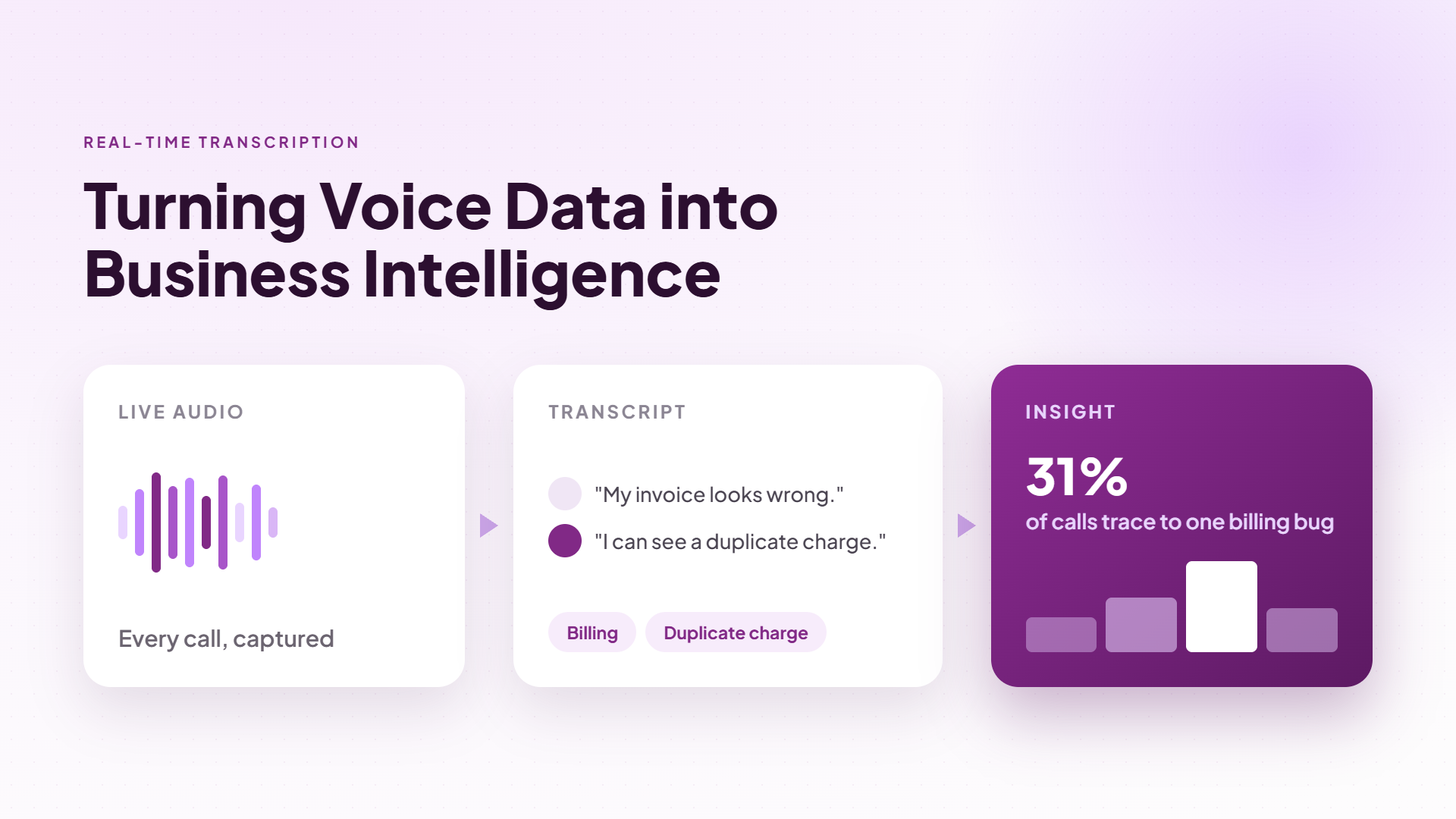
Real-time transcription solves this by converting every word into searchable text as the call happens. Instead of replaying audio, your team can search across conversations the same way they'd search an email inbox — pulling up every call where a customer mentioned a specific competitor, a pricing objection, or a particular feature request, in seconds.
What Changes When Every Call Is Instantly Searchable
For sales teams, this means never losing context on a deal. If a rep goes on vacation mid-deal, whoever picks it up can read the full transcript history instead of relying on secondhand notes or guesswork about what was already discussed and promised.
For support teams, it means faster resolution on repeat contacts. When a customer calls back about an issue they raised last week, the agent has the entire prior conversation on screen instantly — no asking the customer to re-explain everything from scratch.
For managers, it means QA and coaching without listening to hours of recordings. Patterns that used to require manual call audits — common objections, compliance language, tone issues — become visible simply by reviewing transcript text.
Live Transcripts Enable Live Decisions
Because Xorris transcribes calls in real time rather than after the fact, the data is useful while the call is still happening — not just afterward. A live transcript feeding into call logs and context means a supervisor (or the AI agent itself) can react to what's being said in the moment, rather than only learning about an issue in a post-call report.
This is also what makes accurate escalation possible. When an AI voice agent needs to hand a call to a human, the receiving person doesn't need a summary — they can see exactly what's been said so far, in real time, and pick up the conversation without missing a beat.
Transcripts as a Feedback Loop
Every transcript is also a data point that improves what comes next. Recurring phrases that confuse the AI agent, common objections that need a better response, or frequently requested information that isn't yet part of the standard call flow — all of this becomes visible at scale once you're looking at transcript data across hundreds or thousands of calls instead of a handful of recordings.
Combined with full CRM integration, this turns voice data into structured business intelligence: not just "what was said," but patterns across what's being said, searchable and reportable the same way you'd analyze any other business dataset.
From Compliance Record to Strategic Asset
Many businesses initially adopt call transcription for compliance or dispute-resolution reasons — having a record of what was actually said. That's a valid use case, but it undersells what transcription can do. Treated as an active data source rather than a passive archive, transcripts reveal:
Which objections come up most often, and how successfully reps handle them
Which callback promises are consistently kept or missed
Where customer sentiment shifts negative during a call, and why
Which product questions come up so frequently they belong on your website or FAQ
Turning Transcripts Into Reports, Not Just Records
Raw transcripts are useful for individual lookups, but their real value at scale comes from aggregation. Once you have hundreds or thousands of transcribed calls, patterns become visible that no single conversation could reveal on its own — which objections are trending upward this month, which callback promises are most often broken, which regions or agents produce the highest resolution rates on the first call.
Turning that raw text into structured reporting typically means tagging or categorizing calls by outcome, topic, or sentiment, then reviewing trends over time rather than call by call. Teams that build this into a regular cadence — a weekly or monthly review of transcript-derived trends — tend to catch shifts in customer behavior or product issues weeks before they'd otherwise surface through other channels like support tickets or churn data.
This is also where the combination of transcription and full call logs pays off. A transcript alone tells you what was said; paired with outcome data, duration, and CRM context, it tells you what worked. That distinction is what separates a transcript archive from a genuine business intelligence source.
Handling Transcript Data Responsibly
As call transcription becomes a standard part of business operations, it's worth being thoughtful about how that data is stored, accessed, and used — particularly for calls that touch personal or sensitive information. Best practice generally includes limiting transcript access to the team members who need it, being clear with callers that conversations may be recorded and transcribed where required by local regulations, and applying the same data retention and security discipline to transcripts as you would to any other customer data your business holds.
This isn't just a compliance checkbox — it also protects the value of the data itself. Transcript archives that are well-organized, access-controlled, and consistently structured are far more useful for reporting and analysis down the line than data that's been handled inconsistently from the start. Building good data hygiene in early, while transcript volume is still manageable, is much easier than retrofitting it once you're working with years of accumulated call history.
Getting Started
If your business is still relying on manual notes or post-call summaries, the fastest win is simply turning transcription on and letting a few weeks of data accumulate before deciding what to build on top of it. The patterns tend to surface quickly once every call is captured in full, in real time, and stored in one searchable place alongside call logs and outcomes.
Want to see live call transcription in action? Book a free demo and watch transcripts populate in real time during a live call, or try Xorris free to start capturing every conversation today.