Scaling Your Support Team Without Hiring: The Xorris Advantage
Michael Ross
Customer Success Manager
Share
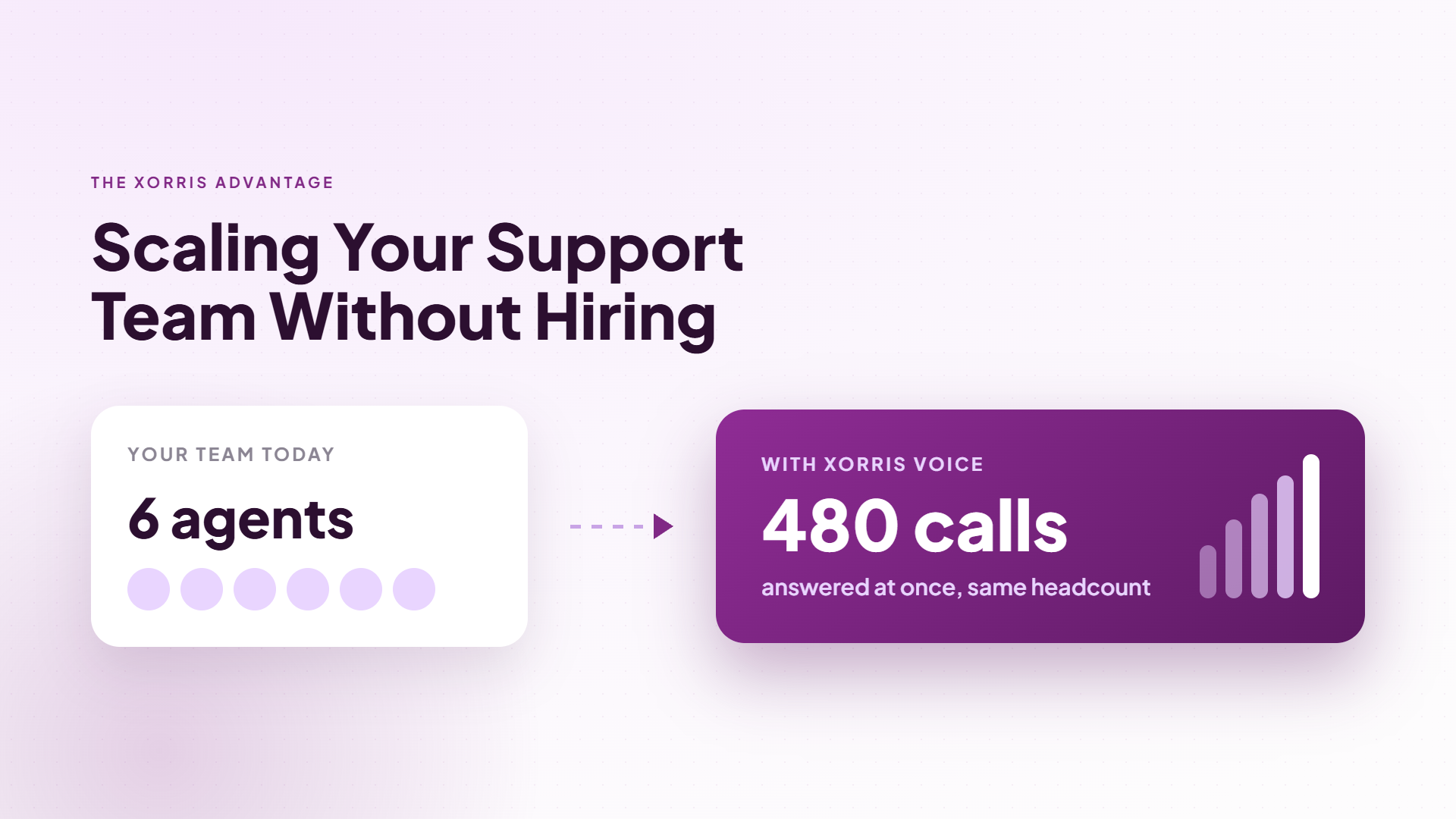
Every support leader eventually hits the same wall: call volume is growing, customers expect faster responses around the clock, and the obvious answer — hire more agents — is slow, expensive, and hard to reverse when volume dips again. There's a better lever to pull first.
The Real Cost of Scaling by Headcount
Adding a single new support hire isn't just a salary line. It's recruiting time, onboarding, training on your product and tone, ramp-up before they're fully productive, and ongoing management overhead. And even a fully staffed team hits a hard ceiling: human dialers and agents can only handle a certain volume of calls per hour, no matter how efficient they are. When a surge hits — a product launch, a service outage, a seasonal spike — that ceiling shows up exactly when you can least afford it.
Missed connections during those spikes aren't free, either. Leads and support requests that go unanswered quickly lose value, and the customers behind them often don't wait around for a callback.
What Changes with an AI Voice Agent
Xorris's AI voice agent handles the volume that would otherwise require hiring — without inheriting the ceiling headcount creates. A single deployment can manage thousands of concurrent conversations, which means a traffic spike doesn't require an emergency hiring sprint.
Specifically, an AI voice agent covers:
24/7 inbound coverage. Calls are answered live at 2 p.m. and 2 a.m. alike — no more after-hours calls routing to voicemail and going cold.
Consistent quality on every call. Unlike a rotating cast of new hires still learning the product, the AI agent applies the same context, tone, and knowledge to every single conversation.
Instant callback scheduling. When the AI can't fully resolve an issue itself, it books a callback automatically instead of leaving the customer to call back and start over.
Full transcripts and logs. Every interaction is recorded and searchable, so there's no loss of institutional knowledge when volume shifts or priorities change.
Personalized, Not Generic
A common concern with AI-driven support is that it will feel impersonal. In practice, the opposite is true when it's set up well. Because each agent is configured with a name, role, and context — and because it has access to prior call history and CRM data — conversations can sound remarkably close to your best team member on their best day, consistently, every single call.
Customers who've experienced this shift describe it plainly: after-hours calls that used to go unanswered are now captured every time, and every callback and transcript lives in one place instead of scattered across notebooks and inboxes.
Where Humans Still Matter Most
Scaling without hiring doesn't mean removing people from support entirely. It means being deliberate about where human judgment adds the most value — complex escalations, emotionally sensitive conversations, high-value accounts — while the AI agent absorbs the repetitive, time-sensitive, and after-hours volume that burns out human teams anyway.
This is where call logs and context matter most. When an AI agent hands a conversation to a human, that person isn't starting cold — they see the full transcript, the outcome, and the reason for escalation in the same dashboard, so the handoff feels seamless to the customer.
Global Support Without Global Headcount
Scaling support across regions traditionally meant hiring local teams to handle language, dialect, and time zone coverage. With voice AI routed through localized carrier networks across 150+ countries, that geographic scaling problem changes shape entirely — coverage expands without a parallel expansion in payroll.
Measuring the ROI of Scaling Without Hiring
The financial case for AI-driven support scaling is easiest to see when you compare it directly against the cost of hiring. A single new support hire typically involves weeks of recruiting, a ramp-up period before they're fully productive, ongoing management time, and ongoing salary and benefits regardless of call volume that week. An AI voice agent's costs, by contrast, scale with usage rather than headcount — there's no idle cost during a slow week and no hiring lag during a busy one.
Beyond raw cost, the metrics worth tracking when evaluating AI-driven scaling include:
Inbound answer rate, especially outside standard business hours
Average time to first response on both inbound and outbound
Callback completion rate — how often a promised follow-up actually happens
Escalation rate and quality — how smoothly complex calls hand off to a human when needed
Customer sentiment trends, visible directly in call transcripts over time
Support leaders who track these consistently tend to find that the biggest early win isn't cost reduction — it's coverage. Calls that used to go unanswered are now answered, every time, which shows up in customer satisfaction and retention numbers before it shows up in the budget.
A Blended Model, Not a Replacement Model
It's worth being direct about what "scaling without hiring" actually means in practice: it's not about eliminating your support team, it's about changing what growth requires. Instead of every increase in volume triggering a hiring conversation, volume increases get absorbed by the AI layer first, and your human team's headcount grows only when the type of work — not just the volume — genuinely requires more people.
This blended model tends to produce a healthier team dynamic, too. Support reps spend less time on repetitive, low-complexity calls that are easy to burn out on, and more time on the escalations and relationship-building conversations that actually benefit from a human touch. Retention among support staff often improves as a side effect, since the job shifts toward the more engaging parts of the role.
Planning Your Transition
If you're considering this shift, start by identifying which portion of your current call volume is genuinely repetitive or time-sensitive — intake, scheduling, after-hours triage, status updates — versus which portion requires real judgment or relationship context. The former is exactly what an AI voice agent should absorb first; the latter is where your human team should stay firmly in the loop. A pilot program focused on just the repetitive slice is usually the fastest way to prove the model out before expanding further.
The Bottom Line
Hiring will always have a place in a growing support organization — but it shouldn't be the default answer every time volume increases. An AI voice agent gives support leaders a scaling lever that responds in minutes, not months, and that holds quality steady no matter how much volume comes through.
Curious what AI-powered support scaling looks like for your team? Book a free demo or start free and see how Xorris keeps every call — and every callback — covered.