5 Common Pitfalls to Avoid When Deploying Voice AI
Jessica Wu
Implementation Specialist
Share
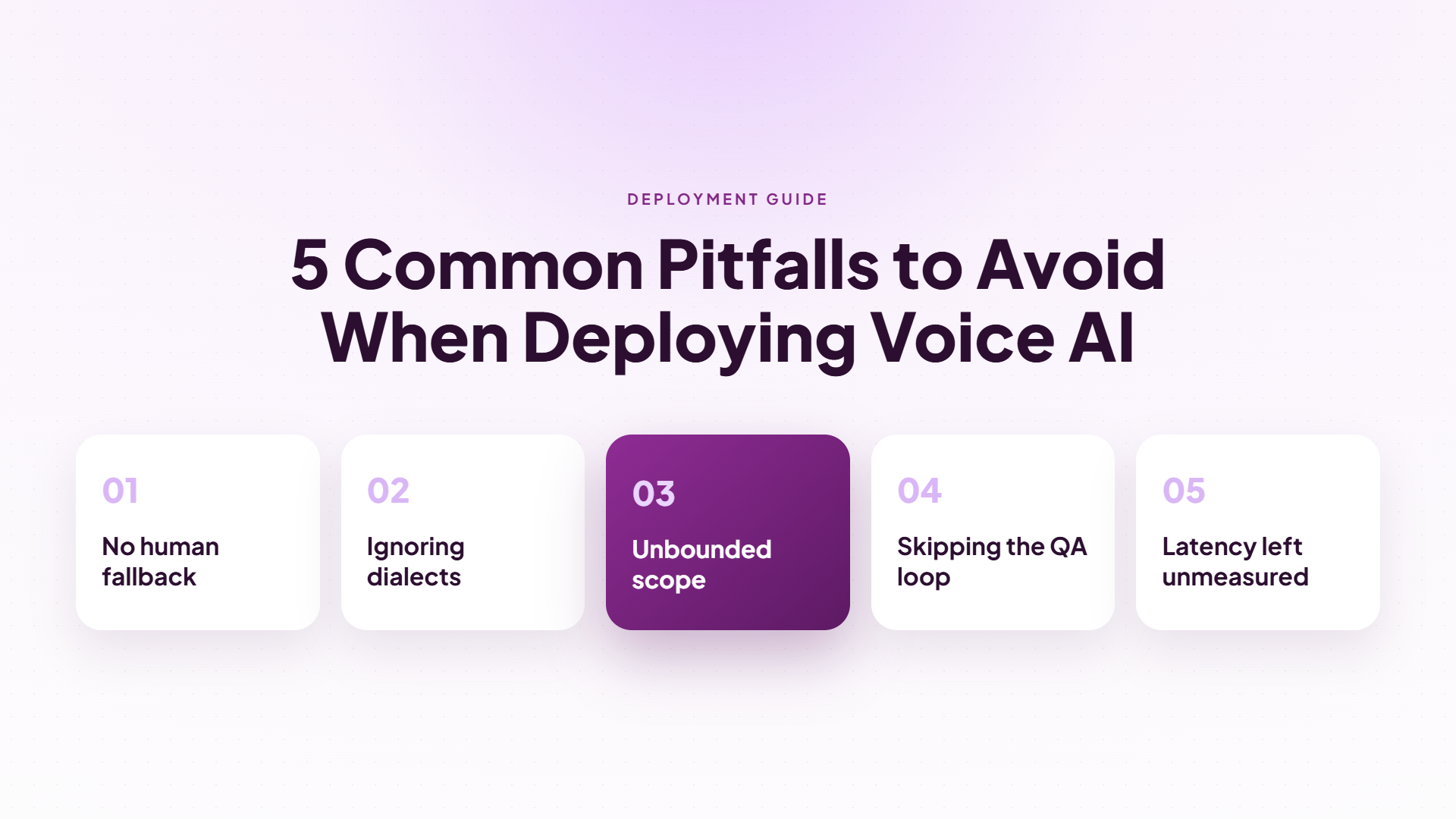
A voice AI rollout can fail for reasons that have nothing to do with the technology itself. In our experience helping businesses stand up AI calling agents, the same handful of mistakes come up again and again — and they're almost all avoidable with the right setup. Here are the five most common, and how to sidestep each one.
1. Launching Without Clear Agent Context
The single biggest mistake businesses make is treating an AI voice agent like a generic script reader instead of giving it a defined identity. An agent launched with no name, no defined role, and no context behaves exactly how you'd expect: generic, robotic, and easy for callers to tune out.
Fix it: Before launch, define who the agent is (name and role), what it's allowed to say and offer, and what context it should pull in for each call — prior interactions, CRM data, the reason for the call. Xorris agents are configured with name, role, and full context before the first call goes out, precisely because that context is what makes a conversation feel coherent instead of scripted.
2. Skipping the Pilot Phase
It's tempting to deploy voice AI across your entire call volume on day one, especially when the upside looks obvious. But rolling out untested at full scale means any gaps in configuration — a misunderstood intent, an awkward handoff, an incorrect answer — show up in front of your entire customer base at once, not a controlled subset.
Fix it: Run a pilot program first. Test the agent against a limited slice of real call volume, review transcripts closely, and refine before expanding. A structured pilot catches configuration issues while the blast radius is still small, and it gives your team confidence in how the agent performs before it's handling your full inbound and outbound volume.
3. Ignoring the Escalation Path
Voice AI is powerful, but it isn't meant to replace every human conversation — and treating it that way creates a frustrating dead end for callers with complex or sensitive needs. When an AI agent hits the edge of what it can resolve and there's no clear path to a human, customers feel stuck, and that frustration reflects on the whole deployment.
Fix it: Design the escalation path before launch, not after a bad call happens. Decide explicitly what happens when the AI can't finish the call itself — whether that's a warm handoff to a live agent, a scheduled callback, or an immediate transfer for specific trigger phrases. The goal isn't for the AI to handle everything; it's for every call to end with the caller's need actually being met, even if that means handing off partway through.
4. Treating Transcripts and Logs as an Afterthought
Some businesses deploy voice AI purely for the calls themselves and don't build a habit of reviewing what the data is telling them. That's a missed opportunity — and it also means configuration problems can run unnoticed for weeks.
Fix it: Make transcript review part of the regular workflow, not a one-time audit. Every call is transcribed and logged in real time, with duration, outcome, and full context saved automatically — use that data actively to spot recurring misunderstandings, common objections, or patterns worth feeding back into agent configuration. Teams that treat this as ongoing intelligence, not just a compliance record, get meaningfully more value from their deployment.
5. Underestimating Infrastructure and Call Quality
An excellent conversational model still fails if the call itself sounds choppy, drops mid-sentence, or has noticeable lag — customers judge the experience holistically, and audio quality issues get blamed on "the AI" even when the underlying model is performing well.
Fix it: Prioritize infrastructure alongside conversational quality when evaluating a voice AI platform. Look for tier-1 carrier partnerships, high uptime guarantees, and strong call quality benchmarks — Xorris routes calls through 100+ tier-1 carrier partners across 150+ countries with 99.99% uptime and consistently high Mean Opinion Score (MOS) audio quality, because a great model on a bad connection is still a bad call.
Bonus Pitfall: Setting It Up and Walking Away
Voice AI is sometimes treated as a "set it and forget it" tool — configure it once, launch it, and assume it will keep performing the same way indefinitely. In reality, your business changes: pricing updates, new products launch, promotions come and go, and common customer questions shift over time. An agent still running on launch-day configuration months later will start giving outdated answers, even if nothing about the underlying technology has changed.
Fix it: Assign clear ownership for ongoing agent management, not just initial setup. That means someone is responsible for updating scripts and context when offerings change, reviewing transcripts regularly for signs the agent is struggling with new types of questions, and treating configuration as a living part of the system rather than a launch-day checkbox. Structured onboarding and account management support exist precisely to make this ongoing maintenance manageable rather than something that falls through the cracks internally.
A Realistic Rollout Timeline
To put these fixes into a concrete plan, a realistic voice AI deployment generally moves through four stages:
Configuration and context-building — defining the agent's identity, scope, and the data it should pull from, typically over one to two weeks depending on integration complexity.
Pilot phase — running the agent against a limited, real slice of call volume, closely reviewing transcripts and outcomes, and refining configuration based on what actually happens on live calls.
Controlled expansion — gradually increasing volume once pilot performance is solid, while escalation paths and edge cases are still being actively monitored.
Full deployment with ongoing review — the agent handles full volume, but transcript review and configuration updates continue as a standing process rather than a one-time task.
Businesses that rush past stages one and two are the ones most likely to run into the other pitfalls on this list, because problems that would have surfaced in a controlled pilot instead show up at full volume, in front of every caller.
Putting It All Together
None of these pitfalls are exotic — they're the same operational discipline that any new system rollout requires: define scope clearly, test before scaling, plan for the edge cases, use the data you're already collecting, and don't skimp on the infrastructure underneath. Businesses that get the deployment right the first time avoid the credibility hit of a rocky rollout and start seeing ROI faster.
Want a deployment that avoids these mistakes from day one? Book a free demo and talk to the Xorris team about pilot programs, onboarding, and structured rollout support — or get started free.