Understanding Natural Language Processing in the Gulf Region
Omar Al-Fayed
Lead Linguist
Share
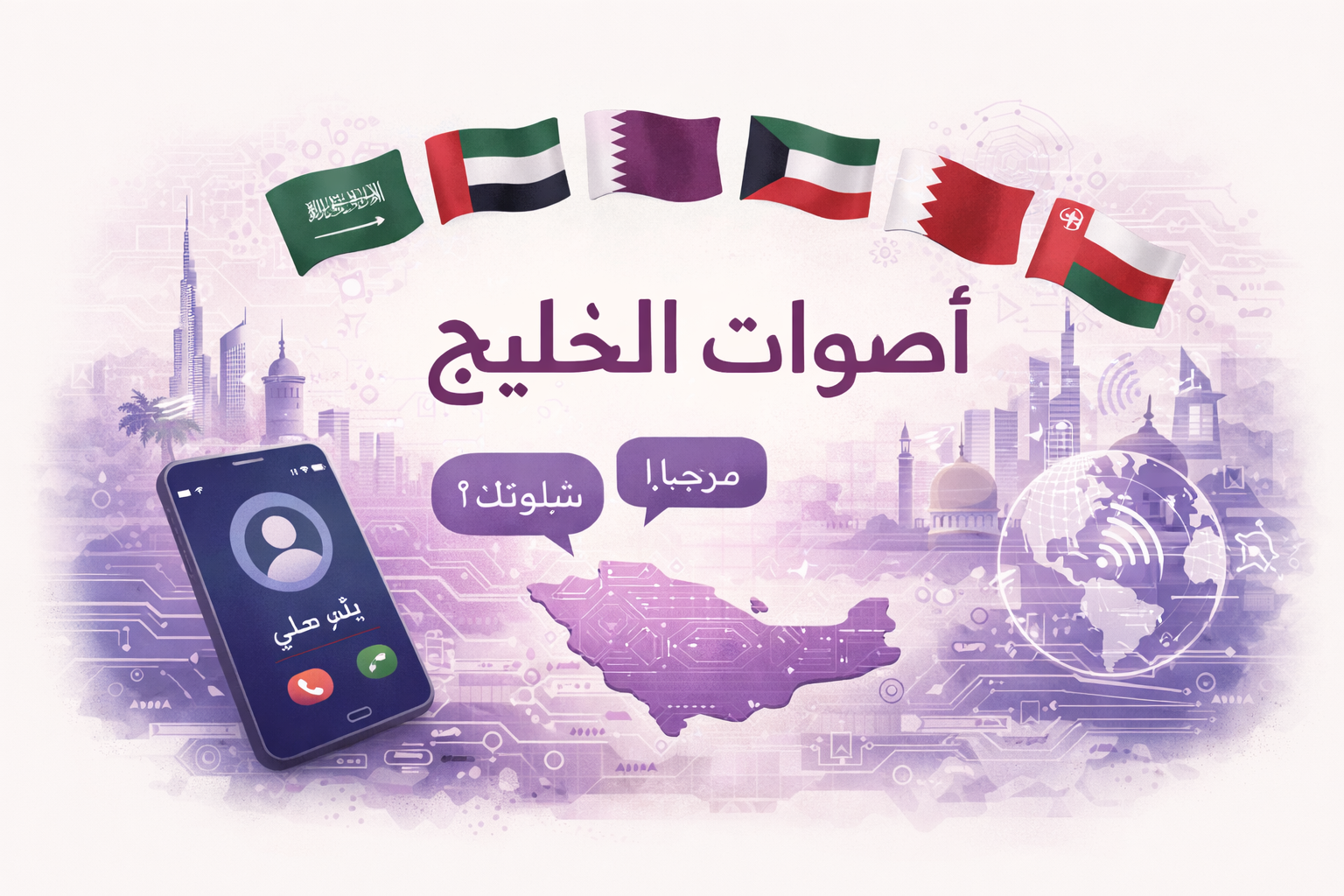
Deploying voice AI in the Gulf region isn't the same problem as deploying it in the US or UK. English-language natural language processing has had years of dominant investment, huge training datasets, and relatively uniform accents to work with. Arabic — and Gulf Arabic specifically — is a different challenge entirely, and getting it wrong shows up immediately in a live call.
Why Gulf Arabic Is Uniquely Difficult for NLP
Arabic isn't one language for NLP purposes — it's a family of related but distinct varieties, and the gap between them matters enormously for voice AI.
Modern Standard Arabic (MSA) is the formal, written form used in news broadcasts and official documents. It's what most Arabic NLP models are trained on primarily, because it's what's most abundantly available in text form.
Gulf Arabic (Khaleeji) is what people actually speak in the UAE, Saudi Arabia, Qatar, Kuwait, Bahrain, and Oman — and it diverges from MSA in vocabulary, pronunciation, and grammar. A voice agent trained only on MSA will sound stiff and formal on a call, and worse, may simply misunderstand common colloquial phrasing.
On top of that, Gulf Arabic itself isn't uniform. Emirati, Saudi, Kuwaiti, and Bahraini speech each carry distinct vocabulary and accent patterns. A system tuned for one doesn't automatically generalize to the others.
Code-Switching Is the Norm, Not the Exception
One of the biggest practical challenges for voice AI in the Gulf is code-switching — speakers moving fluidly between Arabic and English within a single sentence, sometimes within a single phrase. This is extremely common in Gulf business contexts, where English is widely used alongside Arabic in commerce, technology, and daily conversation.
A caller might say a full sentence that starts in Arabic and ends in English, or drop an English business term into an otherwise Arabic sentence. NLP systems trained on "pure" single-language datasets tend to break down here — they either misinterpret the English fragment as noise or fail to parse the sentence structure correctly. Handling this well requires models specifically trained on mixed-language speech patterns, not just two separate language models bolted together.
Accent and Dialect Recognition in Real Time
Beyond vocabulary, accent recognition is its own hurdle. Pronunciation differences across Gulf dialects can change how the same word sounds enough to confuse a system tuned too narrowly. Effective voice AI for the region needs training data that spans the accent diversity of the actual calling population — not just a single "Arabic" voice model treated as one-size-fits-all.
This is also where latency matters. Recognizing dialect and adjusting response in real time — without an awkward pause while the system "catches up" — is what separates a voice agent that feels natural from one that feels like it's translating on a delay.
Cultural Context Shapes the Conversation, Not Just the Words
Localization in the Gulf goes beyond language mechanics. Business etiquette, appropriate formality, and conversational pacing all differ from Western call norms — Gulf business conversations often carry more relationship-building context before getting to the point, and tone matters as much as content.
An AI voice agent operating in this region needs to be configured with that context in mind: the right level of formality, appropriate greetings, and pacing that doesn't feel rushed or transactional when the caller expects otherwise.
Infrastructure Matters as Much as Language
Localized NLP is only half the equation — call quality depends on the infrastructure carrying the conversation. Voice calls routed through localized carrier networks in the region reduce latency and improve audio clarity, which directly affects how well any NLP model can do its job. A perfectly tuned language model still fails on a call with dropped audio or lag, because the system can't accurately parse what it can't clearly hear.
This is why Xorris's approach to the Gulf region combines dialect-aware language handling with tier-1 carrier routing across the region — treating accurate understanding and clean audio as two halves of the same problem, not separate concerns.
What Good Gulf-Region Voice AI Looks Like in Practice
A well-built system in this region should be able to:
Understand Gulf Arabic dialects without defaulting to a stiff, overly formal MSA response
Follow a conversation that switches between Arabic and English mid-sentence
Adapt tone and pacing to match regional business etiquette
Maintain call clarity through localized carrier infrastructure
Log and transcribe mixed-language conversations accurately for CRM and follow-up use
Testing Regional Accuracy Before You Rely On It
Because dialect and code-switching challenges are so specific to the Gulf, generic accuracy benchmarks from a vendor don't tell you much. A model can score well on standardized Arabic NLP benchmarks — which are often built on Modern Standard Arabic — and still struggle badly on an actual Gulf business call. Before rolling out voice AI across the region, it's worth testing against the specific conditions your calls will actually involve:
Real Gulf-dialect speech, not MSA scripted samples
Genuine code-switching patterns, including mid-sentence shifts rather than clean paragraph-level language changes
A range of regional accents, not a single "representative" Arabic voice
Background conditions typical of real calls — mobile connections, background noise, overlapping speech
A short pilot using real call recordings from your target market will surface gaps far faster than reviewing a vendor's general-purpose accuracy claims. This is also where a structured pilot program earns its value — testing against a limited volume of real regional calls before scaling gives you concrete data on dialect handling instead of assumptions.
Formality, Titles, and Relationship-First Conversations
Gulf business culture places real weight on how a conversation opens and how respect is conveyed through language choices — not just what's ultimately being offered or requested. Getting straight to business too quickly, using an overly casual tone, or skipping appropriate greetings and titles can undercut an otherwise well-targeted call before the substance is even reached.
This is a configuration detail as much as a language one. An AI voice agent operating in the region needs its opening approach, level of formality, and pacing deliberately set to match regional expectations — not simply translated from a script written for a Western sales or support conversation. The difference between a call that lands well and one that feels off often comes down to these details rather than raw language accuracy alone.
Why This Matters for Businesses Expanding into the Region
For businesses expanding sales or support operations into the UAE, Saudi Arabia, and the broader Gulf, voice AI that only works in English — or only in formal MSA — creates an immediate credibility gap. Customers notice quickly when a system doesn't understand how they actually speak, and that friction undermines trust before a conversation even gets started.
Getting this right isn't a translation exercise. It's a genuinely different NLP problem that requires dialect-specific training, code-switching support, and infrastructure built for the region — not a general-purpose model with an Arabic setting toggled on.
Expanding into the Gulf region? Book a free demo to see how Xorris handles Gulf Arabic dialects and code-switching in real conversations, backed by localized carrier infrastructure across the Middle East.